Barefoot Builder experiment · Conclave
Good decisions need challenge. Challenge is hard to book.
Before committing to a proposal, a pricing decision or a new idea, you want it tested from several angles: commercial, delivery, technical, and someone who simply thinks it's a bad idea.
Conclave is a voice meeting room where a panel of AI personas, each briefed on your documents and holding a clear point of view, discusses the question with you and argues it out.
The experiment
What if you could convene the right panel in minutes, not weeks?
The people whose challenge you need most are usually the hardest to get in a room, and the ones you can get are often too polite to disagree.
Conclave starts from a different idea. You choose a panel from a library of personas, each defined by what they care about, what they push back on and how they speak. You attach the documents that matter. The panel reads them, prepares individually, then meets you in a live voice conversation where they question the idea, disagree with each other and answer when you call on them by name.
The experiment was to find out whether that could feel like a real meeting rather than a chatbot taking turns, and whether the challenge would be specific enough to change a decision.
Where it helps
One room, different panels.
The panel changes with the question. The same system supports very different kinds of meeting.
Testing new ideas
An investor, a user advocate, a builder and a sceptic assess an app or project idea before any time is spent building it.
Reviewing client work
Sales, delivery, commercial and a stand-in for the client read a proposal and challenge the story, the promises and the margin.
Career decisions
A hiring manager, a recruiter, an advocate and a sceptic assess a job description against a CV: whether to apply, and how.
Rehearsal
The panel plays the buying committee or interview panel, stays in character, then drops it to give honest feedback.
What I learned
The hard part isn't the voices. It's the meeting.
Turn-taking is everything
Let AI agents decide for themselves when to speak and they talk over each other or get stuck in loops. A separate conductor decides who speaks next, using simple rules first and a fast scoring model second, with penalties for monologues and back-and-forth.
Latency is a design problem
A two-second pause feels broken in conversation. The fix was to make decisions while people are still talking, so the next speaker is often ready the moment the previous one stops.
Trust comes from sources
Persuasive voices with invented numbers are worse than useless. Agents may only quote figures from their briefing, say where each one came from, and any unsourced number is flagged after the meeting.
Personas need edges
Panels drift towards polite agreement. Personas work when they have clear priorities, specific things they push back on and people they tend to clash with.
Research needs discipline
The researcher is the only part of the system with web access, it is read-only, and a finding is kept only if its exact words appear on the source page.
The control panel matters
Running everything from Airtable means personas, meetings, briefings and actions live where they can be read, edited and reported on, rather than buried in code.
How it fits together
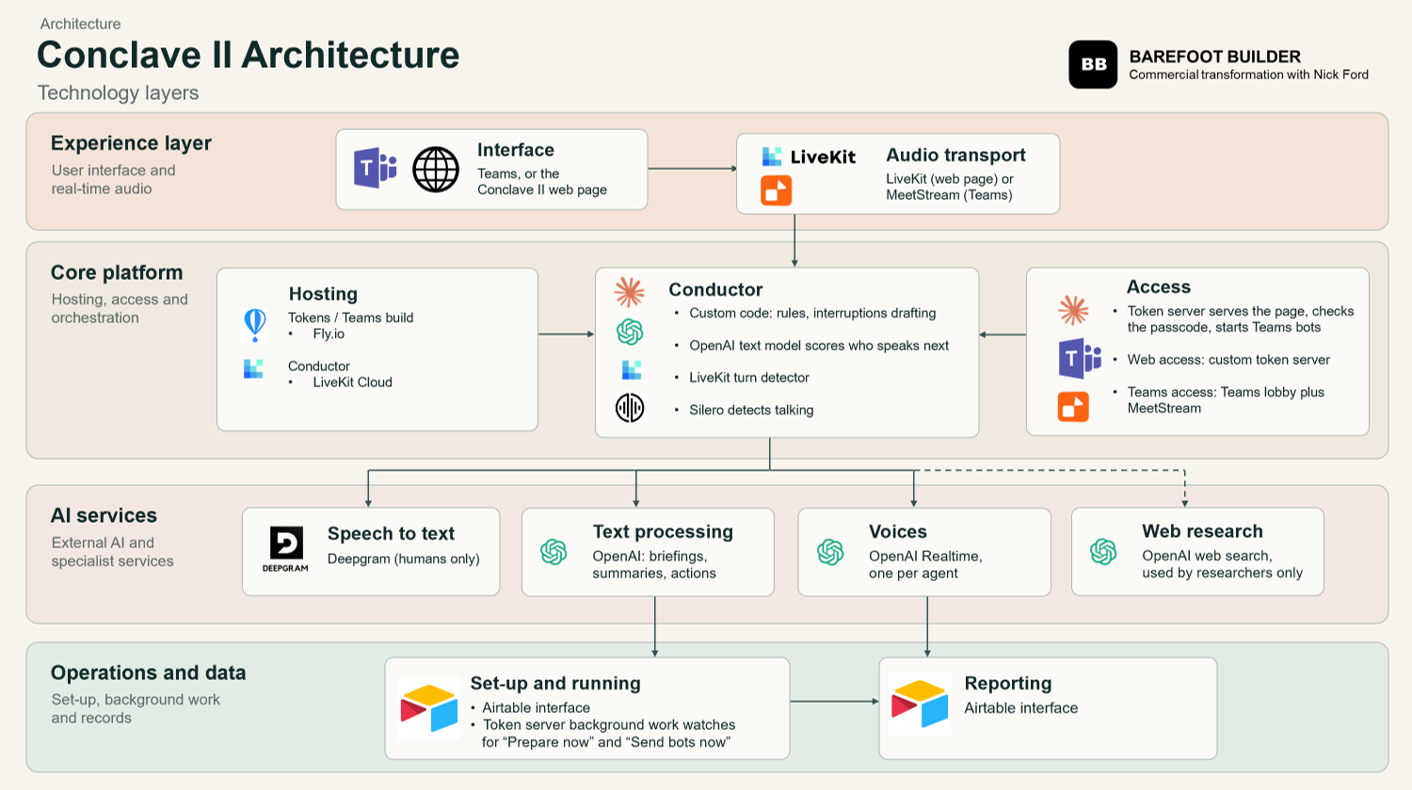
Architecture.
Airtable as the control panel, a conductor that runs the meeting, a separate real-time voice for each persona, and two places to meet: a private Conclave room or Microsoft Teams.
- Airtable holds personas, meetings, documents, briefings and actions.
- A preparation step reads the documents and writes each persona's briefing.
- The conductor transcribes the humans, keeps the meeting state and decides who speaks.
- Each persona speaks with its own real-time voice and never hears the others' audio.
- LiveKit carries the private room; a meeting-bot service carries the Teams version.
Barefoot Builder
Making complex change practical.
This experiment is part of a broader approach: take a commercial or operational problem, make the idea tangible, test the difficult parts and turn what works into something usable.